Tessellating by the Baths: A Roman Pattern Hunt at the Jewry Wall
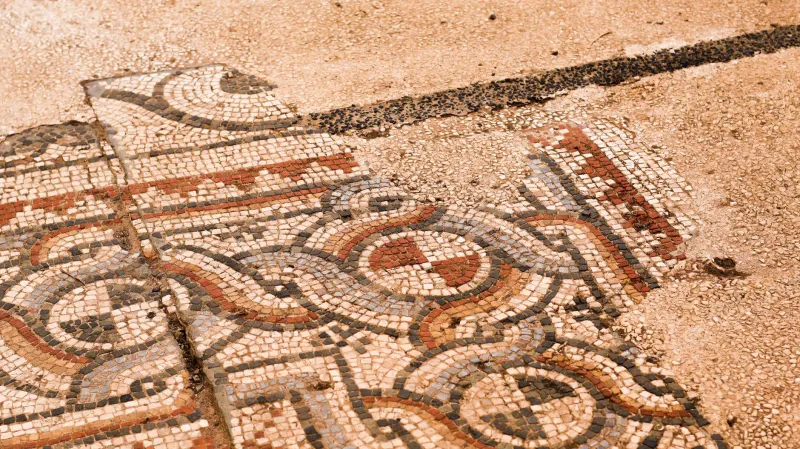
There is a moment, on almost every school trip, when a child looks at a Roman mosaic and says the thing that makes the whole visit worthwhile: "it's just squares, though." And they're right. It is just squares — thousands of them, set at slightly wonky angles by somebody two thousand years ago who had no graph paper and no ruler and still managed a floor that lines up. That's the hook. Once you've noticed the squares, you start noticing the rules underneath them, and the rules are where the maths lives.
A wall, a town and a floor
Ratae Corieltauvorum, as Leicester was known to its Roman occupants, was a proper town with a proper forum and a proper set of public baths. What survives of all that is the Jewry Wall: a long slab of second-century masonry, still standing beside the church of St Nicholas, and one of the largest pieces of Roman walling left anywhere in Britain. It's the sort of thing you can walk past for years without registering, then stop dead in front of once somebody tells you what you're looking at.
The mosaics that came out of the ground around the city centre are the other half of the story. Wealthy townhouses had them; several have been lifted from city sites over the decades and made their way into museum collections. Check opening times before you set out — the museum has been through a redevelopment, and a locked door is a poor ending to a maths trip.
Why symmetry is a Roman habit
Mosaicists weren't doing maths for fun. They were solving a practical problem: cover a floor, leave no gaps, waste nothing, and make the joins look deliberate. That's a tessellation — a set of shapes fitting together with no overlaps and no holes — and the Roman version is one of the oldest engineering solutions in the book.
Only three regular polygons will do the job on their own: the equilateral triangle, the square and the regular hexagon. The reason is an angle argument, and it's the sort of thing a Year 7 class can build from scratch.
Problem 1: The angle test
At any corner where tiles meet, the interior angles must add to exactly 360°.
- Triangle: 60° × 6 = 360° ✓
- Square: 90° × 4 = 360° ✓
- Hexagon: 120° × 3 = 360° ✓
- Pentagon: 108° × 3 = 324°, × 4 = 432° ✗
Ask students to prove the general rule rather than check cases one at a time: an interior angle of a regular n-gon is 180(n − 2)/n degrees, so we need 360 ÷ that to be a whole number. It works for 3, 4 and 6 and for nothing else. A satisfying little dead end.
Problem 2: Name that symmetry
Photograph or sketch a single repeating motif from a mosaic border — a rosette, a knot, a stylised wave. Then classify it using the four moves that keep a pattern looking identical: reflection, rotation, translation and glide reflection.
Useful questions to push towards:
- What is the smallest piece of the pattern that, repeated, generates the whole thing? (This is the fundamental unit, and finding it is half the battle.)
- Does the motif have rotational symmetry, and of what order?
- How many mirror lines run through it — and are any of them diagonal rather than horizontal or vertical?
A four-petalled flower, for instance, has rotation of order 4 and four mirror lines. A simple S-shaped scroll has none of the first and one of the second, but repeating it sideways with a flip produces a glide reflection, which is the sneaky one that catches everybody out.
Problem 3: Design a floor with three shapes
Give each group three shape templates and one hard constraint: the finished patch must tile with no gaps.
A good starting set is squares, equilateral triangles and regular hexagons. Groups will quickly discover that mixing triangles and hexagons works beautifully, that hexagons and squares absolutely do not, and that adding octagons forces you to fill the diamond-shaped holes with squares — the classic 4.8.8 arrangement you see on plenty of Victorian hallway floors.
Then add a design brief: a 2.4 m by 1.8 m entrance hall, tiles no bigger than 30 cm on a side, at most two shape types, and one colour change along a line of symmetry. Suddenly they're doing area, ratio and pattern design at the same time, and arguing about it, which is the point.
Problem 4: The border that doesn't quite fit
Here's where the arithmetic sharpens up. Suppose a border pattern repeats every 7 tiles, and the edge you're tiling is 96 tiles long.
96 ÷ 7 = 13 remainder 5.
So you get thirteen clean repeats and five tiles left over — and those five tiles are exactly where a mosaicist earns their keep, because the pattern has to bend around the corner without looking broken. Options: absorb the remainder into a wider corner panel, stretch the motif, or choose a repeat that divides the length exactly.
Follow-up questions:
- Which repeat lengths between 3 and 9 will fit a 96-tile edge with no remainder? (Answer: 3, 4, 6 and 8.)
- Same question for a 100-tile edge. (Answer: 4 and 5 — a much shorter list, which is why the choice of repeat length matters before you start cutting stone.)
- If a design uses 6-tile repeats and the border is 154 tiles, how many repeats and what remainder? (25 repeats, remainder 4.)
This is modular arithmetic wearing a toga. Students who have met remainders only as a column in a division sum suddenly find them deciding the shape of a building.
On the day
Take squared paper, pencils, a camera and something to lean on. Rubbing crayons work well on raised surfaces but keep them away from anything old and friable — look, don't touch is the rule, and it's a good one. Sketch the wall's coursing, count the tile rows in a border, and photograph one repeating motif to bring back to class.
The walk itself is short: Jewry Wall, the church next door, a loop past the site of the Roman town. But the follow-up work — the angle proofs, the design briefs, the remainders — will fill a couple of lessons, and the mosaics give all of it a reason to exist beyond the exercise book. Somebody, two thousand years ago, worked out that six triangles fit round a point. It's a decent afternoon's homework to work out why.