Silence, Symmetry and a City's Thanks: A Maths Assembly for 11 November
On 11 November 2026, a Wednesday, Leicester schools will pause at 11am. The two-minute silence is not a maths lesson in disguise, but it has a shape that numbers can help us see. This assembly plan uses three simple ideas — a timeline, a flower and a local tally — to give students a way into Remembrance that is thoughtful, practical and quietly mathematical. The aim is not to turn memory into arithmetic. It is to let arithmetic serve memory. The silence was first observed in 1919, a year after the Armistice, and the idea of a shared pause still depends on people agreeing to measure time together.
Begin with a line from 10:59 to 11:01
Draw a long horizontal line on the board. Mark the left end 10:59 and the right end 11:01. Ask pupils where 11:00 sits. They will say the middle. Why? Because two minutes is 120 seconds, and 11:00 is 60 seconds after 10:59 and 60 seconds before 11:01. Fractions, decimals and percentages can follow: the silence begins halfway along the line, at 0.5 of the interval, or 50 per cent of the way. If you mark every 15 seconds, how many intervals are there? Eight. Where does 11:00 fall? After four intervals. If you mark every 10 seconds, how many marks do you need? Twelve intervals, with 11:00 at the sixth mark.
Keep the spoken explanation short. Then let the line do its work: at 11:00, the room falls silent for two minutes. Afterwards, return to the line and ask what the silence occupied. It is not just a gap; it is a measured stretch of time that a whole city shares. In Leicester, that shared stretch reaches from school halls to the Arch of Remembrance in Victoria Park and the city's war memorials. The line on the board is a small model of something much larger.
A poppy is a model, not a perfect flower
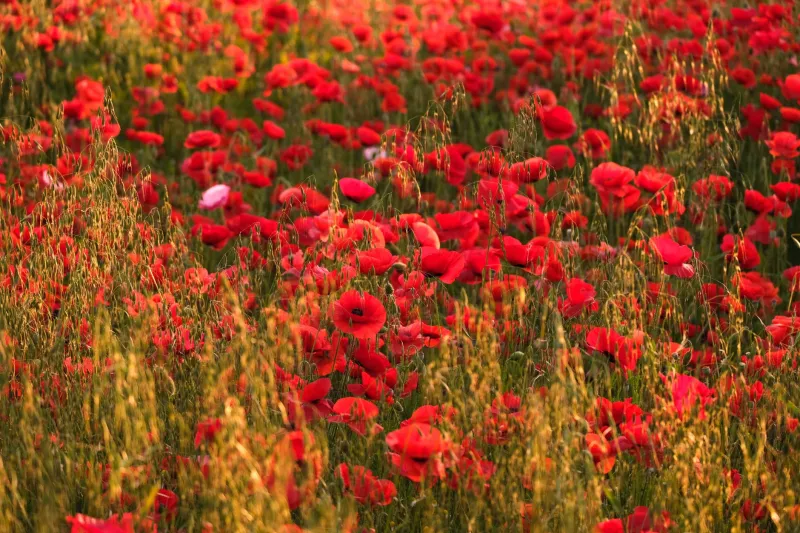
Hand out paper poppies or show the Royal British Legion emblem. A stylised poppy often has four petals arranged around a centre. If those petals are evenly spaced, the shape has rotational symmetry of order four: a quarter turn, 90 degrees, maps it onto itself. It may also have lines of reflection, depending on the design. But real poppies are less tidy. Petals vary, centres are not perfect circles, and wind moves everything.
That gap between the model and the flower is a useful maths conversation. Which symmetries survive? Which are only approximate? Ask pupils to fold a paper circle into quarters and cut a petal shape; open it out and count the repeats. For older students, discuss why designers use symmetry: it is memorable, reproducible and fair. Then place the idealised poppy beside a photograph of a real one. The mathematical question is not which is prettier. It is what we gain and what we lose when we simplify. A poppy emblem is not a botany diagram, just as a number line is not the whole of memory.
Local numbers, handled with care
Numbers can help a school notice participation without turning it into a competition. Before the assembly, ask each class to record one simple thing: how many pupils are wearing a poppy, how many poppies appear in a classroom window display, or how many minutes of silence the school plans to observe. Keep the data small and the questions honest. If four classes each observe two minutes, that is eight minutes in total — but not eight minutes of shared silence. If 30 pupils each bring 50p for a collection, the total is £15; what is the mean contribution? What is the range if one pupil brings £1 and another brings 20p? These are ordinary maths questions, but the context asks pupils to think about giving as a choice, not a score.
At the end, display the numbers beside a sentence that explains what they represent. A tally is only useful if it points back to the people and the purpose. Leicester pupils might compare a count of poppies in a shop window with an estimate for the whole street, then discuss why the estimate might be too high or too low. That is estimation, rounding and reasoning — but it is also a lesson in saying clearly what a number does and does not tell you.
A short assembly script
Here is a five-minute sequence that keeps the maths light and the tone respectful.
- 10:59 — Show the timeline. Ask two quick questions: where is halfway, and how many seconds are in two minutes? The answer to the second is 120.
- 11:00 — Hold the silence. No maths talk during the silence.
- 11:02 — Return to the line. Ask pupils to mark the silence with a bracket and label it as two minutes, 120 seconds, or one-thirtieth of an hour.
- Next — Show the poppy. Ask for one symmetry observation and one difference between the model and a real flower.
- Finally — Share the class tally or collection total, and read a short sentence about what the number stands for.
Printable prompts for discussion
- If the silence starts at 11:00 and lasts 120 seconds, what time does it end? How do you know?
- A paper poppy has four evenly spaced petals. Through what angles can you rotate it and still see the same shape?
- Why might a designer choose a symmetrical poppy instead of a realistic one?
- Our class counted 24 poppies in a window. If there are 6 similar windows, estimate the total. What assumption are you making?
- A collection tin holds £12.40 in 50p and 20p coins. Could there be exactly 30 coins? Explain your reasoning.
- Which is more useful here: an exact count or a good estimate? When might each be appropriate?
- Write one sentence that uses a number to help someone remember, without making the number the point.
Keep the meaning in view
An assembly about Remembrance should not feel like a worksheet. The maths is a handrail, not the destination. Pupils can look at the Arch of Remembrance and notice symmetry, proportion and inscription; they can walk past memorials and notice dates. But the numbers are there to help us ask better questions: How long is two minutes? How many people share them? What does a poppy repeat, and what does it refuse to repeat? If the last question is answered with silence, that is appropriate. The best outcome is not a neat answer. It is a room that has paused, counted carefully and understood a little more about why the counting matters.