Lighting Up the Golden Mile: The Maths Hiding in Leicester's Diwali Celebrations
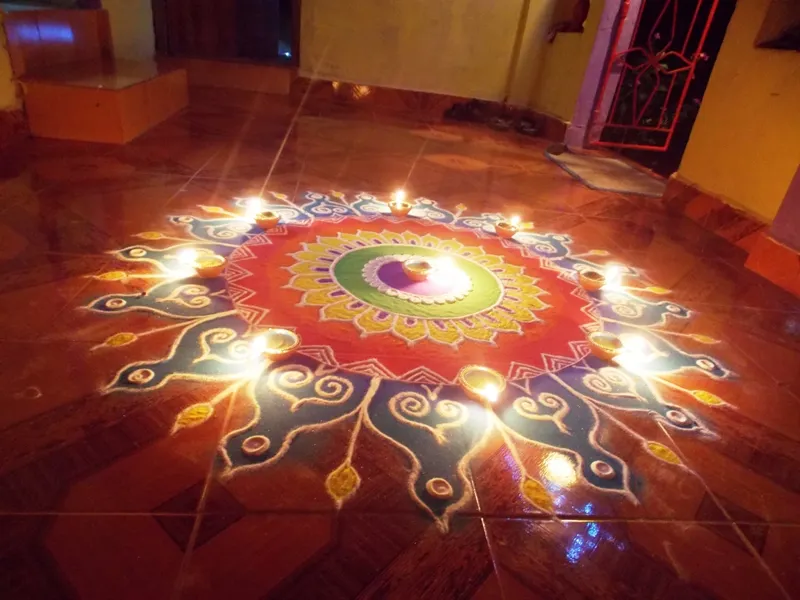
Photo: Dinesh Korgaokar, CC BY-SA 4.0, via Wikimedia Commons
Diwali 2026 has arrived, and Belgrave Road is doing what it does best: turning a city street into a classroom with lights on. Between the rangoli, the queues for mithai and the careful business of lighting diyas, there is enough maths to keep a family or a Year 7 class busy for a fortnight. The trick is not to bolt maths on afterwards. The maths is already there.
Symmetry on Belgrave Road
Rangoli are a gift for geometry. Many designs use reflection symmetry, rotational symmetry, or both. A pattern with four lines of symmetry and rotational symmetry of order four is not just pretty; it is a compact way of describing repetition. Ask students to photograph or sketch three rangoli-style patterns, then classify them. How many lines of symmetry? What is the order of rotation? Does the pattern still work if you change one petal?
A good classroom task is to design a rangoli with exactly four lines of symmetry and rotational symmetry of order four, using only two colours. Then add a constraint: no two adjacent petals may be the same colour. Students quickly discover that symmetry is not decoration. It is a rule that limits possibilities.
For families, try a Golden Mile symmetry hunt. Find three examples of reflection symmetry in shop displays, windows or fabric, and one example of rotational symmetry. Discuss why some patterns have both. The best answers usually come from the least obvious places: a tray of sweets, a folded scarf, a repeating border on a sweet box.
Lighting the diyas in order
Sequencing is the hidden maths of Diwali preparations. Suppose a household lights diyas in rows: one in the first minute, three in the second, five in the third, and so on. The total after n minutes is n squared. After 12 minutes, that is 144 diyas. That is a lot of oil, and a very good reason to check the pattern before promising to light them all.
In class, ask students to write the first few totals and find the rule. Then change the starting point. What if the household begins with five diyas and adds two each minute? How many after ten minutes? The sum is 5 + 7 + 9 + ... + 23, which is 140. Families can run the same problem with actual counters, dried pasta or small sweets. The movement from concrete to symbolic is the point.
How many people are on the Golden Mile?
Crowd estimation is a genuinely useful skill, and Diwali gives it a natural setting. Use a grid-sampling method. Mark out a 10 m by 10 m square, or pace one out, and count the people inside it at a fixed time. Repeat in three different places. Average the counts, then multiply by the number of squares covering the crowd area.
For example, if a 10 m by 10 m patch holds 18 people and the crowd area is roughly 300 m by 12 m, the area is 3,600 square metres. That is 36 patches of 100 square metres, so the estimate is about 648 people. The number is not the point. The assumptions are. Density varies near stalls, children take up less space, and people move. A good estimate comes with a sentence beginning: This assumes...
The probability of a fair share
Sweet-sharing is probability you can eat. Imagine a box of 24 mithai: 10 barfi, 8 ladoo and 6 jalebi. If you pick one at random, the probability of barfi is 10/24, or 5/12. The probability of not picking jalebi is 18/24, or 3/4. If you pick two without replacement, the probability of two ladoo is 8/24 multiplied by 7/23, which is 56/552, or 7/69.
For a family challenge, ask what fair sharing actually means. If four people share the box randomly, is each person equally likely to get a jalebi? What if the youngest chooses first? What if the box is passed round and everyone takes one sweet before anyone takes a second? These questions move probability away from formula and towards fairness, which is where it belongs.
A short family problem set for the Golden Mile
- A rangoli has six identical petals around a centre. What is its rotational symmetry order?
- Diyas are lit in rows of 1, 3, 5, 7 and so on. How many have been lit after 8 rows?
- A 10 m by 10 m patch contains 22 people. The crowd area is about 250 m by 8 m. Estimate the crowd size.
- A bag has 30 sweets: 12 pistachio, 10 coconut and 8 saffron. What is the probability of picking coconut? What is the probability of not picking saffron?
- You light 5 diyas in the first minute, then 2 more each minute than the minute before. How many diyas in total after 10 minutes?
Answers: 1) 6; 2) 64; 3) about 440; 4) 1/3 and 11/15; 5) 140.
The Golden Mile is at its best when it is counted, sketched, estimated and shared. Diwali 2026 gives Leicester a ready-made maths trail. All you need is a pencil, a bit of curiosity and perhaps one sweet for the journey home.