The Timetable Is the Teacher: Leicester Bus Maths Beyond the Textbook
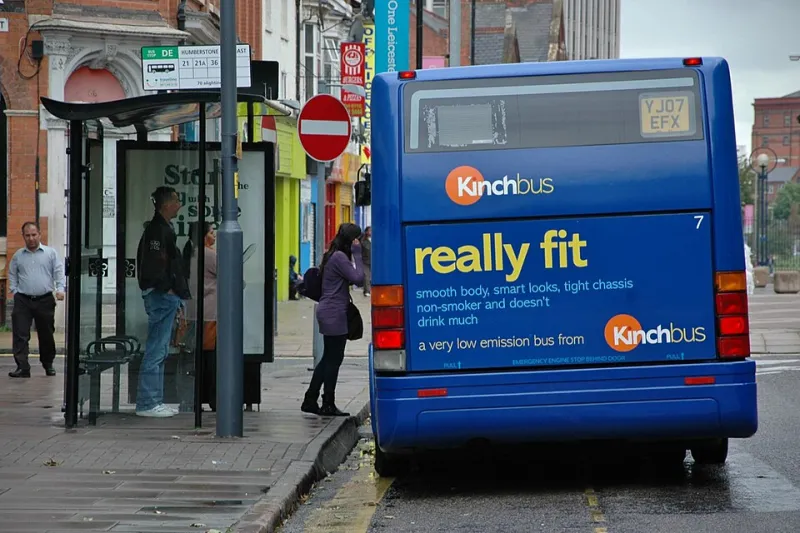
Photo: Motacilla, CC BY-SA 4.0, via Wikimedia Commons
The bus timetable is one of the most underused maths resources in Leicester. It is free, local, changes often enough to feel alive, and it contains functions, averages, graphs, probability and optimisation without ever announcing them. Textbooks invent timetables; Leicester already has them. In 2026, with travel costs and timetables under constant scrutiny, that local data is too good to ignore.
The timetable is a function in disguise
A timetable maps time to departure. If buses leave every 12 minutes from 06:00, the departures are 06:00, 06:12, 06:24 and so on. That is an arithmetic sequence, and it is also a function. Ask students how many departures there are between 06:00 and 09:00 inclusive. The interval is 180 minutes, so there are 15 gaps and 16 departures. If the last bus is at 23:00, the same sequence can be used to check the final departure.
Then make it personal. You arrive at the stop at 07:05. When is the next bus? The wait is 7 minutes. If you arrive at 07:12 exactly, the wait is zero. A simple waiting-time function, W(t) = 12 - (t mod 12), with the sensible exception that a remainder of zero means no wait, does a lot of work. It turns a timetable into algebra without losing the smell of the street.
Frequency, waiting and the maths of patience
Headway is the time between buses. If a route runs every 12 minutes and you arrive at random, your average wait is 6 minutes. That is a neat result, but it depends on assumptions. Real arrivals cluster. Traffic bunches buses together. A route that claims every 12 minutes may deliver two buses close together and then a long gap.
This is a good argument for comparing routes. A service every 10 minutes has a lower average wait than one every 15 minutes, but the difference is more than a number. The probability of waiting more than 10 minutes on a perfectly regular 12-minute service is 2/12, or 1/6. On a 15-minute service it is 5/15, or 1/3. Students can test whether those theoretical probabilities match what they see at a real Leicester stop.
Average speed is a trap
Average speed is total distance divided by total time. It is not the average of the speeds. A 6 km route that takes 30 minutes has an average speed of 12 km/h. If the first half of the journey is at 20 km/h and the second half at 10 km/h, the average is not 15 km/h. It is 10 km divided by 0.25 hours plus 0.5 hours, which gives 13.33 km/h.
Leicester is full of examples. London Road, Belgrave Road, Aylestone Road and Welford Road all have different rhythms. Ask students to find a route where the timetable gives a distance and a journey time, then calculate the average speed. Then ask why the bus cannot travel at that speed for the whole route. Stops, traffic lights, passengers and school runs are all part of the answer.
Network graphs and the art of the transfer
A bus network is a graph. Stops are nodes, routes are edges, and transfers are where graphs become interesting. Which stop has the highest degree? Which journey is shortest by time, and which is shortest by number of stops? Those are different questions, and they often have different answers.
A simple adjacency matrix for five or six stops is enough to start. Students can fill in journey times, then find a route from a suburb to the city centre. Add a constraint: you must change buses at least once. Add another: you have a buggy and need a step-free change. Suddenly the maths has become real, and the answer is not just a number but a plan.
Fares, caps and optimisation
Fare structures are linear functions in disguise. Suppose a day ticket costs £6.20 and a single costs £2.40. Two singles cost £4.80, which is cheaper than the day ticket. Three singles cost £7.20, so the day ticket wins from the third journey onwards. That break-even point is a simple inequality, but it is also a life skill.
Group tickets, student discounts and caps add layers. A family of four may find that a group ticket beats four singles. A student may find that a term pass beats paying daily. Ask students to model the best option for different travel patterns. Then ask what the model ignores: reliability, time, weather, whether the walk is pleasant. Good modelling knows its limits.
A Leicester-specific question bank
- Route A leaves every 10 minutes from 06:30 to 22:30. How many departures are there? (97)
- Route B leaves every 15 minutes. Both routes leave at 07:00. When do they next leave together? (07:30)
- You arrive at a stop at 08:07 for a 12-minute service that started at 06:00. How long do you wait? (5 minutes)
- A 7.2 km route takes 36 minutes. What is the average speed? (12 km/h)
- A 10 km journey takes 30 minutes for the first 5 km and 30 minutes for the second 5 km. What is the average speed? (10 km/h)
- Stops A, B, C and D are connected with journey times of 4, 6 and 3 minutes. Find the shortest route from A to D if you must pass through C.
- A day ticket costs £6.20 and a single costs £2.40. How many singles make the day ticket worth buying? (3)
- A minibus must collect six students. Use a greedy method to choose the order, then explain why greedy may not be best.
Leicester's buses are not just transport. They are a live data set with timetables, uncertainty, graphs and trade-offs. The next time a textbook asks students to imagine a bus service, replace it with a Leicester route. The maths will be harder to simplify, and that is exactly why it is better.