Before the Bulbs Come On: A Leicester Crowd-Maths Field Guide
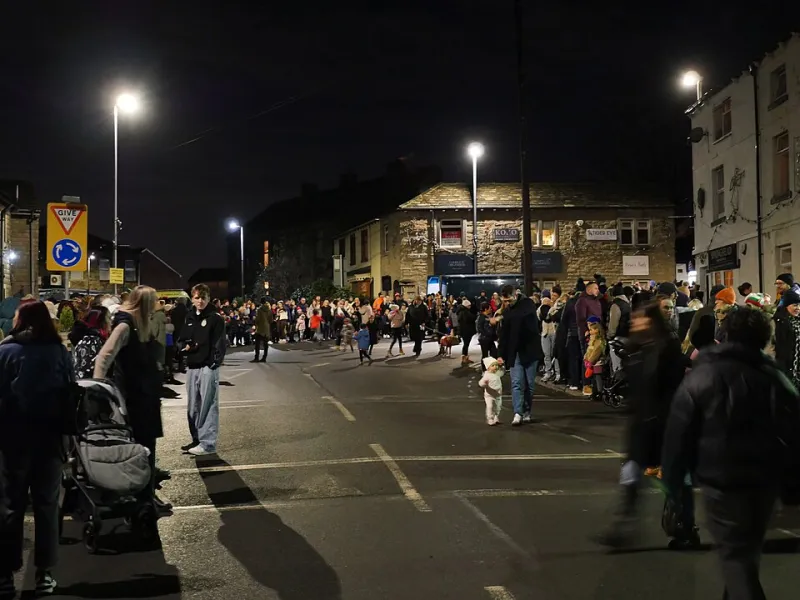
Photo: habiloid , CC BY-SA 2.0, via Wikimedia Commons
Leicester's Christmas lights switch-on is one of those city-centre events that looks like pure sparkle and behaves like a maths problem. In 2026, as the crowd gathers around the Clock Tower and spills down Humberstone Gate, every family is inside a live model: arrivals, service points, bottlenecks, and the oldest question in the world — how long until the hot chocolate?
This is not a reason to stay home. It is a reason to take a stopwatch.
The city centre is a queueing network
Queueing theory sounds like something for call centres and supermarket tills. It is really the maths of anything that arrives faster than it can be served. At a lights switch-on, people arrive in waves. Some stop at a food stall. Some need the toilets. Some want the funfair. Some just want to get to the bus stop before the crowd turns.
In classroom terms, we have an arrival rate — say 120 people per hour — and a service rate — say a stall can serve 90 people per hour. When arrivals beat service, the queue grows. When service beats arrivals, the queue drains. The ratio of arrival rate to service rate is called utilisation, and it is a neat way to show KS4 students why a queue that looks fine at 5pm can be enormous at 6pm.
You do not need the full theory to use it. You need a count, a timer and a willingness to be approximately right.
Problem 1: the hot chocolate stall
Suppose a stall can serve one customer every 40 seconds. That is 90 customers per hour. At 5.30pm, 18 people are already waiting. What is the expected wait for the person at the back, assuming no one gives up and leaves?
18 × 40 seconds = 720 seconds = 12 minutes.
Now add a twist. Another 120 people arrive over the next hour, but the stall still serves only 90. The queue grows by 30 people per hour. Ask students to sketch a graph of queue length against time. Ask them to estimate when the queue reaches 30 people. This is not just arithmetic; it is modelling.
Problem 2: crowd density on Humberstone Gate
Pick a rectangular patch of pavement. Say it is 60 metres long and 20 metres wide, so 1,200 square metres. If 3,600 people are standing in it, the density is 3 people per square metre. That is busy. A comfortable browsing density is closer to 1 to 2 people per square metre. Ask students: how many people would fit at 2.5 people per square metre? Answer: 3,000.
Then ask the better question: where does the crowd have to squeeze? A narrow section, a crossing, a stall queue. Density is average; bottlenecks are where averages stop being useful.
Problem 3: the bus queue after the show
A single-decker bus carries about 70 people. After the switch-on, 600 people want the same route. How many buses are needed if everyone is to get on?
600 ÷ 70 = 8.57, so 9 buses.
If buses arrive every 10 minutes, the last bus leaves about 90 minutes after the first. That is a waiting-time estimate, not a promise. Ask students what assumption is doing the work: everyone queues fairly, every bus is full, no one walks, no extra buses appear. Real life is messier. That is the lesson.
Fair queuing is a maths question with manners
A single snake queue feeding several tills is usually fairer than separate queues, because one slow till does not trap one unlucky line. But it can look longer, and longer-looking queues feel slower. This is a lovely discussion point for families: what does fair mean? Same waiting time? Same chance of being served next? First come, first served? Queueing theory can measure waiting; it cannot decide the ethics for you.
Turn the switch-on into a field lesson
Take a stopwatch. Count how many people pass a fixed point in 30 seconds, then double it to estimate a one-minute flow. Count a queue at two different times. Estimate the area of a crowd using paving slabs or a phone map. Do not block pavements, do not climb anything, and do not stand in the road. The best crowd maths is boringly safe.
The switch-on is a reminder that maths is not only on paper. It is in the shuffle towards the lights, the pause at the burger van, and the collective sigh when the bus fills up. Leicester's 2026 lights will be bright. The maths underneath them is brighter still.