Don't Count the Deer: A Sampling Argument from Bradgate Park
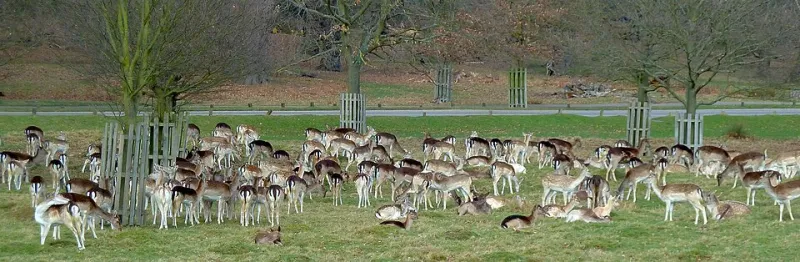
Photo: Rob Farrow , CC BY-SA 2.0, via Wikimedia Commons
Every autumn, someone standing near the Ruins at Bradgate Park asks the same question out loud, usually to nobody in particular: "How many deer live here, then?"
It sounds like a counting question. It isn't. The herd is spread across hundreds of acres of bracken, hillside and old oaks, it moves all day, and the fallow deer in particular have a talent for being exactly where you are not. Even a ranger with decades of experience would not claim to count the deer one by one.
So here's the opinion, stated plainly: estimating is not a cop-out. It is the actual skill, and it deserves better press than it gets in school.
The method worth knowing
Capture-recapture, sometimes called the Lincoln-Petersen method, is a genuinely beautiful piece of reasoning that fits on the back of a napkin.
The idea: catch a sample, mark them, put them back. Later, catch a second sample and see how many of them are already marked.
If 30 deer are marked and released into a population of N, then a random second sample of 40 should contain roughly 30/N of the marked animals. If 12 of your 40 turn out to have marks, then:
N̂ ≈ (marked × second sample) ÷ marked in second sample = (30 × 40) ÷ 12 = 100
That's it. One division. The whole trick is that the proportion of marked animals in your second sample estimates the proportion of marked animals in the population.
The assumptions, said out loud
The method is simple, which makes it easy to trust too much. Four conditions have to hold:
- The population is closed. No deer wandering in or out, no births, no deaths, during the study.
- Marks stay on and don't change behaviour. A collared deer that suddenly avoids humans breaks the maths.
- Every animal is equally likely to be caught. Not true if some deer live near the café and others hide in the bracken.
- The second sample is random and independent of the first. No heading back to the same glade because that's where the first lot were.
In real ecology, all four are slightly violated, which is why surveyors use refinements — the Chapman estimator, or the sophisticated models behind modern wildlife surveying. But the core logic is exactly the napkin version, and it's the core logic that students should meet first.
The bag-of-pasta game
This is the activity I'd push at any family, classroom or park-visit group: it takes ten minutes, costs about a pound, and makes the sampling variation visible in a way no diagram can.
You need: a cloth bag, 150–200 dried pasta shapes (or counters), and a marker pen.
- Take 20 pieces out, dot each one with the marker, and return them to the bag. These are your marked deer. Nobody counts the rest — that's the point.
- Shake thoroughly. Draw 30 pieces. Count how many have dots.
- Apply the formula. Write the estimate on a sticky note.
- Return everything, shake again, and repeat five times.
Then look at the sticky notes together. A typical run might give marked counts of 6, 3, 4, 7 and 2, producing estimates of 100, 200, 150, 86 and 300 from the same bag. The true answer never changed. Only the sample did.
That spread is the single most useful thing a young statistician can see. It builds the instinct — the one that stops people saying "the survey said 100, so there are 100" — that an estimate comes with a range, and that a small sample wobbles more than a large one.
Running it on the day
If you're heading to Bradgate, don't try to handle deer. Use the same reasoning on something you can actually sample.
- Pick a fixed spot and a fixed twenty-minute window, once in the morning and once in the afternoon.
- Record every deer you can see, with binoculars, from the path.
- Note conditions: time, weather, how many people are about, whether the deer are in the open or under cover.
- Keep to the paths, keep your distance, and don't feed anything.
The comparison between your two windows is a proper data set, and comparing it with a friend's counts from a different spot is better still. Two observers, same park, different numbers — that's not a failure, that's sampling.
Why this matters beyond deer
We ask students to "estimate" constantly and then mark them down for it. Same for phrases like "roughly", "about" and "in the region of". But outside the exam hall, almost every number anyone cares about is an estimate: how many people came to the Diwali lights, how many bikes use a cycle lane, how much food a food bank will need in December.
Estimating is a technique, with assumptions, corrections and honest error bars. It has more intellectual content than most exact arithmetic — the difficulty is in knowing what to count, what to assume, and how wrong you might be.
So next time someone asks how many deer live at Bradgate, don't shrug. Say you can't count them, but you can certainly estimate them — and then explain why those are two very different sentences.