Crumbs, Costs and Queues: A Festive Maths Field Notebook for Leicester Families
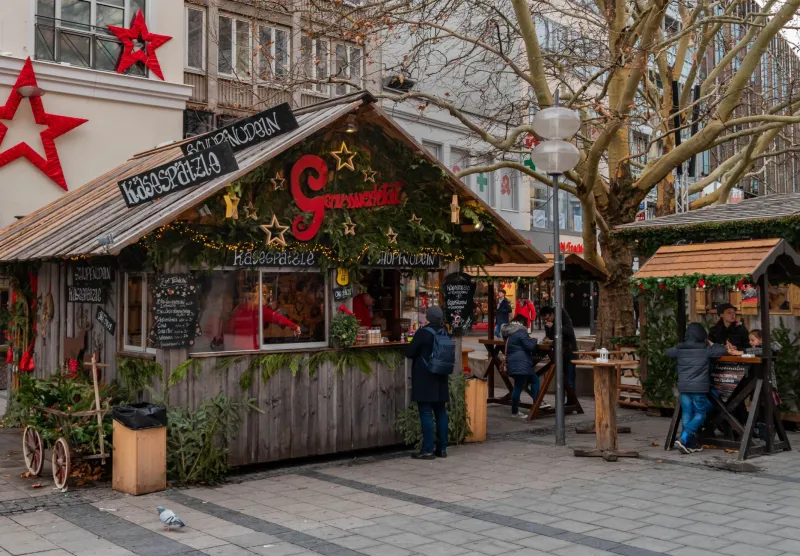
There is a particular Leicester December moment worth savouring. The lights are on, the air smells of sugar and spice, and somewhere between the Clock Tower and the wooden huts you find yourself holding a small paper bag and wondering whether six mince pies for £4.50 is actually better value than four for £3.20. That is not a distraction from maths. It is maths, wearing a woolly hat.
This field notebook is designed for families who fancy a festive wander with a few numbers tucked in their pocket. It works best when nobody announces that you are “doing maths”. Instead, treat the market as a set of friendly puzzles: guess first, check second, and let the best question win.
Start with a guess, then check
Estimation is the secret engine of market maths. Before you read a price label, ask everyone to guess. How much for a small bag of roasted chestnuts? How many people are in that queue? How long until the hot chocolate is in your hand? Write the guesses down, or just remember them dramatically.
The checking part matters. At a stall, count the people ahead of you, watch how quickly they are served, and see whether your estimate was close. If three customers are served in two minutes, roughly how long might eight people take? You do not need a calculator. You need a sensible rate, a bit of rounding, and the humility to admit that the queue may speed up when someone has exact change.
The unit-price picnic
Mince pies are an excellent place to begin because they come in packs of different sizes and weights. Suppose one stall sells a box of six for £4.50 and another sells four for £3.20. The first box costs 75p per pie; the second costs 80p per pie. So far, the bigger box wins.
But what if the boxes are different weights? A 300g box for £4.50 is £1.50 per 100g. A 250g box for £3.20 is £1.28 per 100g. Suddenly the smaller box looks stronger on weight, even though it loses on pie count. This is the useful awkwardness of real-life maths: the “best” answer depends on the question. Are you feeding a crowd, or looking for the richest crumb per penny?
The same trick works with mulled drinks. A 300ml cup at £3.50 is about £1.17 per 100ml. A 500ml cup at £5.20 is £1.04 per 100ml. The larger cup is better value per millilitre, but only if you actually want that much. Value and appetite are not the same thing.
Queue-length forecasting
Queues are living data sets. Pick a stall with a visible serving point — hot food is usually best — and watch for two minutes. Count how many customers are served. That gives you a rough service rate. If the stall serves about four people every three minutes, then twelve people ahead is roughly nine minutes of waiting, plus a little chaos allowance for someone who cannot decide between brown sauce and ketchup.
Try a second stall nearby. Compare the number of people waiting with the speed of service. A long queue at a fast stall may be quicker than a short queue at a slow one. This is the same lesson that appears in lunchtime queues at Leicester Market, dressed in tinsel. Ask your family to predict which queue will move first, then time it. The result is never quite as tidy as the arithmetic, and that is part of the fun.
The true cost of a festive feast
A Christmas feast is a shopping list with ratios hiding inside it. Choose a small imaginary gathering — say six people — and build a mini menu: mince pies, a wedge of Christmas cake, perhaps some cheese and a bottle of something fizzy. Note the price and quantity of each item. Then work out the cost per person.
A simple table helps:
| Item | Price | Quantity | Cost per person for six |
|---|---|---|---|
| Mince pies | £4.50 | 6 pies | 75p per pie |
| Christmas cake | £9.00 | 12 slices | £1.50 per slice |
| Cheese | £6.40 | 400g | about £1.07 per 100g |
| Fizzy drink | £3.60 | 750ml | 60p per person if shared equally |
Now add the real-world questions. If two people do not like mince pies, should you buy fewer? If the cake is sliced more thinly, does the cost per person fall or just the size of the slice? If you buy a larger cheese because it is cheaper per gram, will any of it be left by Twelfth Night? The “true cost” includes what gets eaten, what gets wasted, and what gets pushed to the back of the fridge with good intentions.
A printable field sheet for your next wander
Print or copy these prompts onto a small sheet and take them into the city centre. Tick them off as you go.
- The pie comparison. Find two packs of mince pies. Work out the cost per pie and the cost per 100g. Which is better value, and does your answer change if you use different measures?
- The drink ratio. Compare two sizes of hot chocolate or mulled drink. Calculate the cost per 100ml. Which would you buy, and why?
- The queue estimate. Watch a stall for two minutes. Estimate how long a queue of ten people will take. Check your estimate with a timer.
- The gift-box surface area. Find a rectangular gift box. Estimate its length, width and height, then work out the area of wrapping paper needed to cover it, allowing a little overlap.
- The festive total. Choose three items for a pretend family feast. Add the prices, round to the nearest pound, and check the exact total.
- The percentage stall. Find a sign offering a discount. If a £12 item is reduced by 25%, what is the new price? What if the discount is £2 instead?
- The crowd count. Estimate how many people are in a small section of the market. Count a patch, then multiply by the number of similar patches.
- The change challenge. Pay for an item costing £6.35 with a £10 note. What change should you get? Try another purchase with a £20 note.
- The best-value snack. Compare three snacks using cost per 100g. Decide which one wins on maths and which one wins on taste.
Keep the festive spirit in charge
Market maths should feel like a game you happen to be playing while shopping, not a worksheet with tinsel taped to it. Let children choose the stall. Let them make the first guess. If a calculation goes wrong, follow the mistake — often it reveals something more interesting than the correct answer.
And if all that pricing and predicting becomes too much, buy a mince pie, split it carefully, and calculate the cost per bite. It is not the most rigorous unit in the world, but it is a very Leicester way to finish a festive maths trail.