Shelves, Spines and Place Value: A Number Trail for Leicester Families
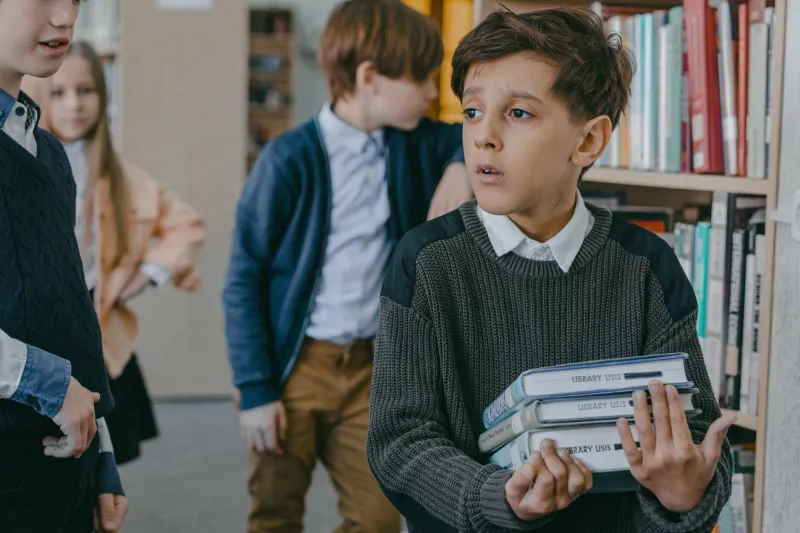
On a grey November afternoon, Leicester Central Library on Bishop Street is doing what libraries do best: offering shelter, warmth and rather a lot of numbers. They are printed on spine labels, tucked into catalogue records and stuck to the ends of shelves. Most of us walk past them. A maths trail invites us to stop.
A maths trail hiding in plain sight
The Dewey Decimal Classification is a way of organising knowledge by number. It starts at 000 for general works and runs through the hundreds: 100 for philosophy and psychology, 300 for social sciences, 500 for science, 600 for technology, 700 for arts and recreation, and so on up to 900 for history and geography. Within each hundred, further digits narrow the subject down.
You do not need to memorise the whole system to enjoy it. The point of a family trail is smaller and sharper: notice that the library is already sorted by number, then use that sorting to practise place value, ordering and intervals. It is problem solving with a shelf number in your hand.
Three moves to start the trail
- Begin at the 000s. Ask each child to find a label beginning with 0. What does the first digit tell them? What does the second digit change?
- Choose one bay in the 500s or 600s. Spend five minutes reading labels aloud and putting three of them in order from smallest to largest.
- Finish near the 900s with a comparison task: find two labels that are close in value but not next to each other on the shelf. Why might that happen?
Print the clue cards below at A6, punch a corner and tie them together with string. A pencil each is useful; pens are best left in bags near the special collections.
Clue cards with a bit of bite
- Find a label in the 300s where the tens digit is 4 and the units digit is odd.
- Find two neighbouring shelf labels whose difference is exactly 10.
- Locate a class number between 641 and 642. What subject sits there?
- Find a label with a 7 in the hundreds place and a 3 in the tens place.
- Choose one bay. Write down its smallest and largest labels, then describe the interval in words.
- Find a label whose digits add to 15. Compare answers with another family.
Some shelves will not contain every number. Gaps are not a failure; they are part of the lesson. A library is a living collection, and the numbers on the shelves are a map rather than a perfect sequence.
Place value with a paperback in your hand
A label such as 523 is not just a name. It has a hundreds digit, a tens digit and a units digit: five hundreds, two tens and three units. Ask children to read it that way, then ask which shelf is closer: 500 or 600? Which digit matters most when deciding? This is place value made physical, and it is much friendlier than a worksheet because the answer is right there on the shelf.
Dewey numbers also behave like decimals. The point is not always printed, but the ordering still follows decimal rules: 513.2 comes before 513.21. That small fact is a lovely curiosity for older children. It explains why a very specific book can sit immediately after a broader one, and why the shelf order is not simply counting upwards in whole numbers.
Intervals: the shelf as a number line
Every bay covers an interval. If one end is 510 and the other is 520, the bay represents a stretch of ten class numbers, even if only a few are occupied. Ask families to estimate how many books sit between two labels, then count a small section to check. Estimation, counting and comparison all arrive in the same activity.
At the catalogue terminal, try a quick search for a familiar subject — Leicester, trains, cookery, football — and note the class numbers that appear. Sort them from smallest to largest. Which numbers cluster together? Which are outliers? This turns the catalogue into a data set and gives the trail a second act.
Classification is a maths game too
Classification is not only a library skill. It is a mathematical habit: decide on a rule, apply it consistently, then see what happens at the edges. Ask families to invent a classification for their kitchen at home. Do cereals go in the 000s because they are general morning fuel? Are socks 100s because they are a philosophy? The categories do not need to be sensible. They need to be consistent enough that someone else could use them.
Back in the library, compare that homemade system with Dewey. Why do cookbooks sit around 641? Why do ball games appear in the 790s? The answers are historical as well as logical. Classification involves choices, and choices can be questioned. That is a useful message for young problem-solvers.
For teachers: extensions beyond the visit
Before the visit, give pupils a set of shelf labels and ask them to order them. Include a few decimal examples such as 513.2 and 513.21 to spark discussion. During the visit, set an interval hunt: find a bay whose labels span less than 20, then one whose labels span more than 100. After the visit, ask pupils to design a classification for the classroom library and calculate how much shelf space each section needs.
For a quicker follow-up, use a number line on the whiteboard and place three real class numbers on it. Ask what lies between them and what lies beyond. The library has supplied the context; the classroom can supply the generalisation.
Practical notes for a family visit
Leicester Central Library is a public building, so check opening hours before travelling and be mindful of quiet areas. The children’s library is a good starting point for younger mathematicians, though adult shelves often provide clearer three-digit labels for place-value work. Library staff are usually happy to help if a clue card sends you hunting in the wrong aisle. Bring pencils, small notebooks and a sense of curiosity rather than a race to finish.
A final curiosity
The Dewey system was first published in 1876 and has been revised many times since. It is not a perfect map of knowledge, and no classification ever is. But it gives Leicester families a ready-made number trail through a wonderful building: 000 to 999, one shelf at a time.